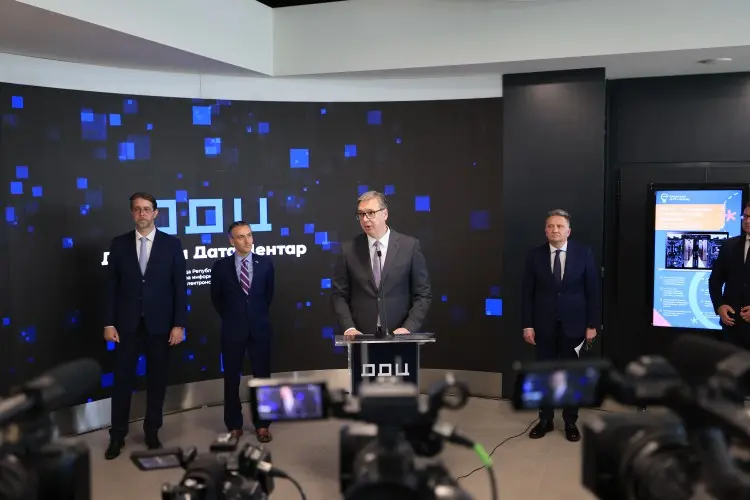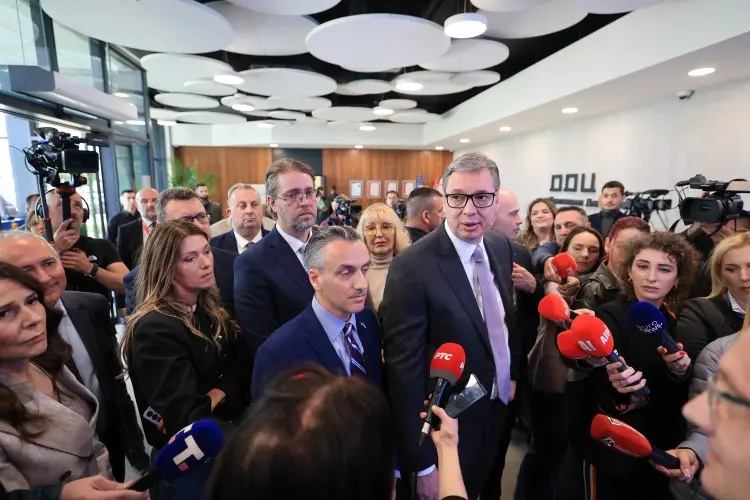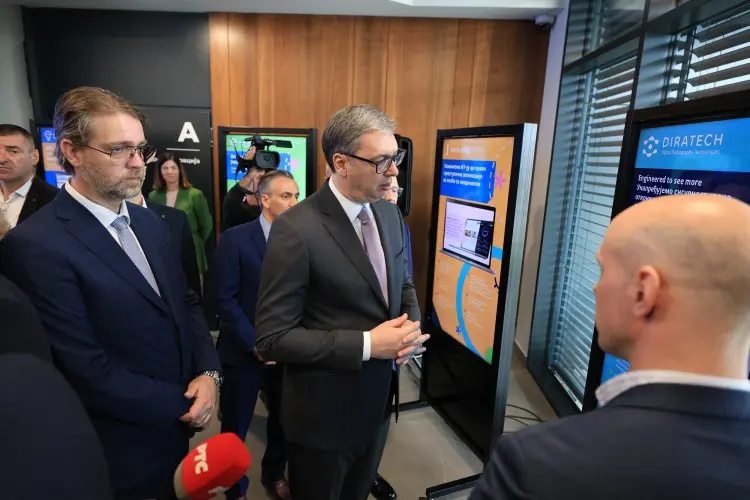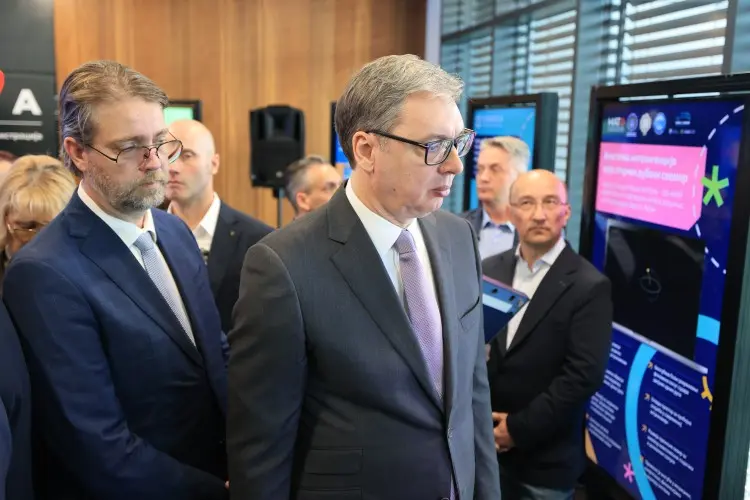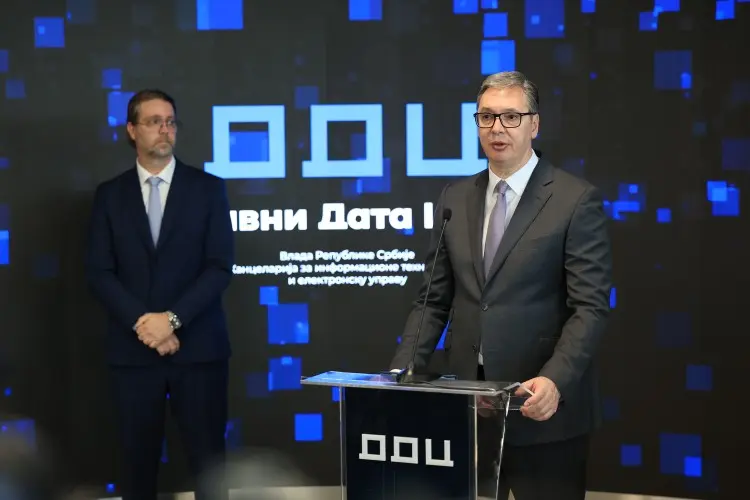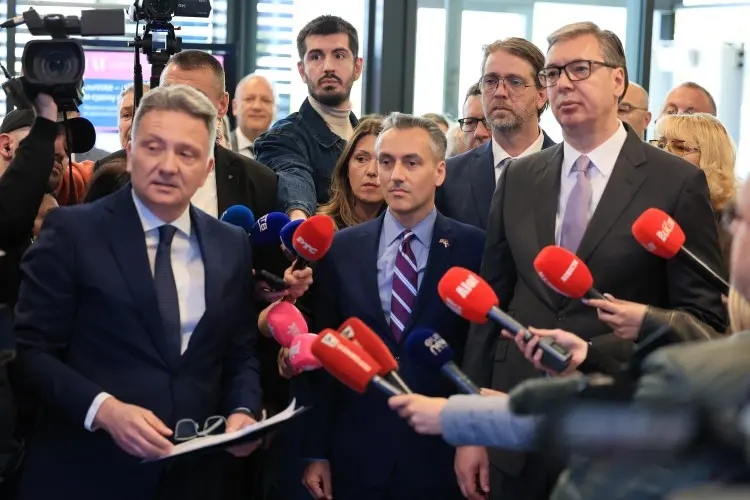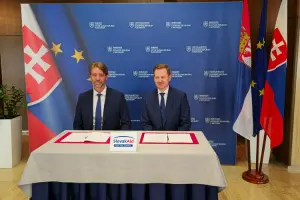

The President of the Republic of Serbia, Aleksandar Vučić, attended today in Kragujevac, together with the Deputy Chief of Mission at the U.S. Embassy in Belgrade, Alexander Titolo, the activation of new modules at the State Data Center, a new supercomputer, and solar panels, further strengthening the national digital infrastructure. The event was also attended by Dr. Mihailo Jovanović, Director of the Office for Information Technology and eGovernment, Mayor of Kragujevac Nikola Dašić, Head of the Šumadija Administrative District Biljana Ilić Stošić, and Deputy Mayor Dejan Ružić.
During his visit to Kragujevac, President Vučić stated that Serbia is making strong investments in the development of digital infrastructure and innovative technologies, emphasizing that such projects are crucial for the country’s future. Many thanks to our partners for their cooperation, which, together with our clear ambition, is leading Serbia into the future. What has been presented today in Kragujevac has no competition in the region; in this respect, only Poland can compare with us, the President said, adding that some more developed countries are currently behind Serbia in this field.
He stressed the importance of cooperation with international partners, particularly with the company Nvidia, without whose technology and expertise, as he noted, such progress would not have been possible. The President assessed that Serbia must not miss the “artificial intelligence revolution”, emphasizing that this field represents an opportunity for accelerated development.
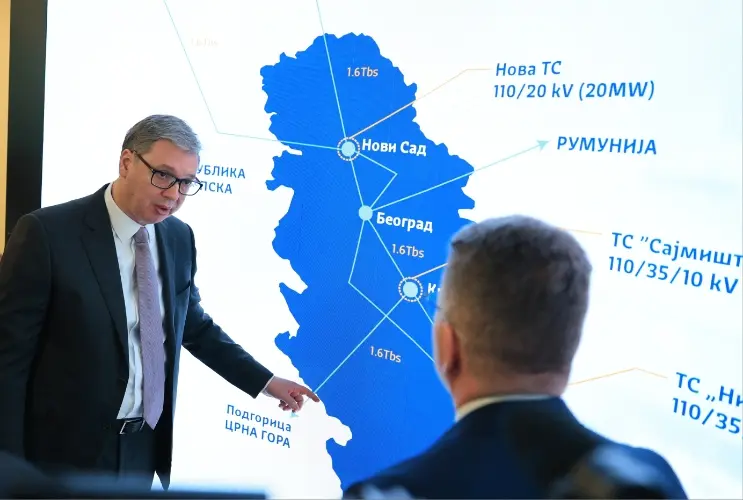
Speaking about the State Data Center in Kragujevac, which holds the highest European TIER 4 certification, Vučić described this moment as historic for Serbia’s digital infrastructure. With the activation of the new modules and supercomputer, an additional eight megawatts of energy capacity have been secured, bringing the total capacity to 14 megawatts, while the total value of the investment exceeds EUR 100 million. A second supercomputer, worth EUR 5 million and almost seven times more powerful than the previous one, was also put into operation today, with a third, more advanced system expected soon.
Addressing security issues, the President noted that Serbia has been exposed to millions of cyber attacks but has managed to protect its infrastructure, and that key state institutions are being relocated to the Data Center to ensure the highest level of data protection. He added that the Data Center is already generating significant revenue from international companies leasing its capacities, with expectations that this revenue will continue to grow.
In addition to digital development, the President pointed to the importance of infrastructure and economic projects in Kragujevac and the Šumadija region -including the construction of the Northern Bypass, the development of the road network, and investments in healthcare - emphasizing that the upcoming reconstruction of the University Clinical Centre, worth more than EUR 100 million, best illustrates the scale of change. He particularly highlighted the importance of industry and the company Stellantis, stressing that the state remains committed to strengthening the economy and creating new jobs.
I believe that by 2030 we will achieve all the goals set and that Kragujevac will become one of Serbia’s key development centres, President Vučić concluded, announcing support for the establishment of a faculty of robotics and information technology as another step toward a knowledge-based society.
Dr. Mihailo Jovanović, Director of the Office for Information Technology and eGovernment, stated that the State Data Center and the Innovation District in Kragujevac represent the largest digital infrastructure construction site in Serbia.
He emphasized that with the construction of the Innovation District, whose first building is expected to be completed by 1 September, Kragujevac will become the “Serbian Silicon Valley”, with major international companies arriving. As he noted, preliminary agreements have already been signed with Oracle Corporation, Honeywell, and Palo Alto Networks, while SAP is joining as a new partner.
Speaking about technological capacities, Jovanović pointed out that with the third supercomputer, a total of 720 graphics processing units will be available, with access provided not only to scientific institutions and start-ups but also to the business sector. He added that development is based on the highest European standards (EN 50600), as well as energy-efficient solutions, including water cooling and the use of solar energy.
Kragujevac has evolved from an industrial centre of automotive production into a modern IT hub of Serbia, Mayor Nikola Dašić stated, assessing that the State Data Center has fundamentally transformed the city’s economic profile. With the Innovation District and the development of the Science and Technology Park, as well as plans to establish a new faculty focused on artificial intelligence and robotics, a unique system will be completed in Kragujevac which, as he emphasized, has no counterpart in this part of Europe, Dašić concluded.